Pay in installments of $5.75 with
 ,
,
 and
and

Shipping Estimate
USA
- USA
- CAN
- USA
- CAN
Ships within 48 hours · Estimated delivery Jul 3 - Jul 8
 Promo Codes Available:
For Your Every Summer RSVP, with Code: SUMMER15
Description
input buffer guitar pedal Minimal Series Pedal Board Junction Box with BJF Buffer (OC-M-JBBUF)One Control Minimal Series Pedal Board Junction Box with BJF Buffer saves you time in all sorts of situations such as on stage, in the studio, and at the rehearsal room. Every pedalboard needs a tool like this a small box with two inputs and two outputs which is very simple, but makes a tremendous difference in your sound. With the OC PBJB, the pedalboard itself is like one big effects pedal, just connect the cable from the guitar to the PBJB, and
One Control Minimal Series Pedal Board Junction Box with BJF Buffer saves you time in all sorts of situations such as on-stage, in the studio, and at the rehearsal room. Every pedalboard needs a tool like this – a small box with two inputs and two outputs which is very simple, but makes a tremendous difference in your sound.
With the OC PBJB, the pedalboard itself is like one big effects pedal, just connect the cable from the guitar to the PBJB, and from the PBJB to the amplifier, and the setup is complete.
This way it doesn't take extra time to take the stage and play the gig.
If there is a buffer in the input part of the pedalboard, you can limit any change in your signal due to cable length, patch cables, and the connections following the input. You can also use it as an output buffer instead of on the input.
THE BJF BUFFER:
This amazing circuit is installed in many switchers from One Control and is one of the most natural-sounding buffer circuits ever created that destroys the old image people have from using old buffer circuits that changed the tone of the instrument.
Features:
Precise Unity Gain setting to 1
Input impedance will not change the tone
Will not make output signal too strong
Ultra-low noise output
When the input is overloaded, it will not degrade the output tone.
Created at the request of many of the world’s greatest guitarists by Björn Juhl, one of the greatest amp and effects designers in the world, the BJF Buffer is the answer to keeping your tone pristine in all sorts of signal chains, from the stage to the studio.
The more effects that are connected, the stronger the effect when the buffer is connected earlier in the chain and it’s more effective. This is the reason for incorporating the BJF Buffer into the input part. By turning on the BJF Buffer, you can stabilize your base tone to a warm and natural sound. You can also use it as an output buffer depending on the characteristics of the effects in your pedalboard chain.
POLARITY/REVERSE OPTIONS:
The sound of an instrument is a wave that travels through the air. The frequency becomes the pitch, and the vibration width is the loudness of the sound. The sound of the instrument creates a specific sound by mixing multiple waves.
To put it simply, the phase is the starting position of the wave. Even if it is the same waveform, changing the starting position greatly changes the movement of the air at that moment.
If there is only one sound, the phase will not have a big impact on the tone. However, when you combine multiple sounds like guitars and bass, the difference in phase affects the sound.
If you listen to the sound where the phase is reversed with the same waveform at the same distance from the sound source, the waveforms will be canceled, and you will not be able to hear the sound at all. Conversely, if you hear the same waveform and the same phase from the sound source at the same distance, the waveforms overlap, and you can hear it at a loud volume.
Due to the cancellation and overlap of this wave, the difference between sound being audible and being less heard will change greatly throughout the full band ensemble.
The POLARITY/REVERSE switch is used to restore phases that may be inverted depending on the characteristics of the equipment or to match the phases of other parts. This logic may be confusing, but don’t worry - make a sound with the band at rehearsal and set it to the one that can be heard better. Just by itself, the "out of sound" and "power of sound" of the whole band will change.
How to make effective use of the pedalboard:
Except for some expensive models, many pedalboards have high sides - so if you install a pedal at the edge of the board, the cable plug may get caught on the edge and the pedal may float. If you step on the foot switch with a pedal like this, it may lead to cable and pedal failure.
The Pedal Board Junction Box with BJF Buffer has input and output on the top of the enclosure, so you can use it without wasting any space on the pedalboard.
Of course it has a very compact design, so the Pedal Board Junction Box with BJF Buffer does not occupy too much real estate on your pedalboard.
Keeping you out of trouble onstage:
The scene in a live show is very hectic. At practice you have time to set up slowly, but if you panic or get impatient, you tend to make mistakes at the gig. With the OC PBJB, make the best settings in advance and be gig-ready. By using the Pedal Board Junction Box with BJF Buffer, you can move the input/output location according to the composition of the stage without changing the placement in the pedal board.
Prevent cable tangling:
At the live show, the equipment is usually narrowly placed on the stage. It's not uncommon that the input of the amplifier is right behind the guitarists and bassists. Normal pedalboards have inputs on the right and outputs on the left, so cables often get tangled while moving during the live performance. The Pedal Board Junction Box with BJF Buffer allows the input and output of the pedalboard to be in the same position, making it easy to decide the placement of your cable. This is a big help in keeping your cords from getting tangled during your show.
Even small boards are powerful:
The Pedal Board Junction Box with BJF Buffer is a very small size. Therefore, it is very effective not only for boards with large systems, but also for small boards!
How to use:
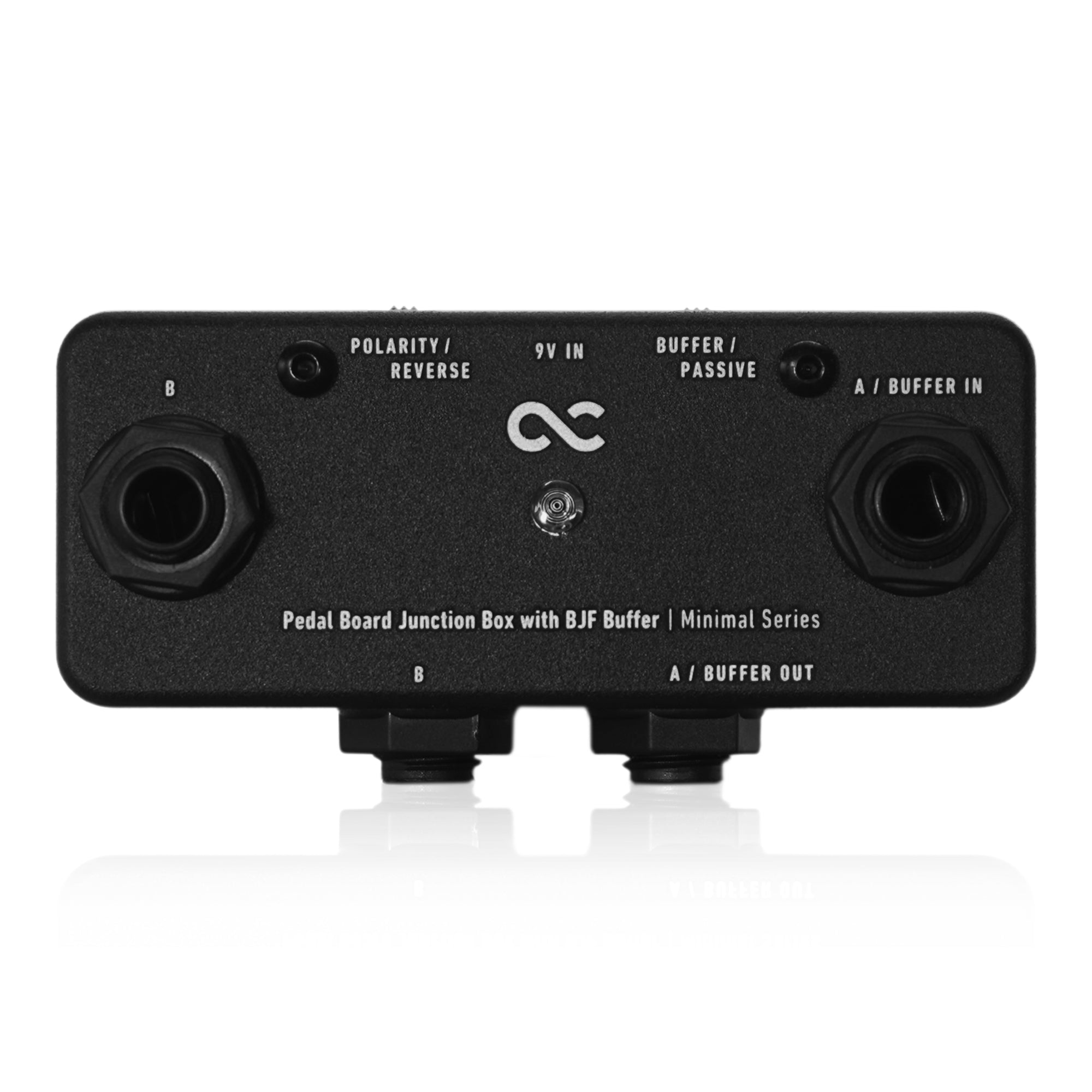
BUFFER/PASSIVE SWITCH: TURNS THE BUFFER ON/OFF. In PASSIVE mode, the buffer is turned off. IF YOU DON'T CONNECT THE POWER, USE PASSIVE MODE.
POLARITY/REVERSE SWITCH: INVERSES THE PHASE BETWEEN THE BUFFER IN/BUFFER OUT JACKS. THIS SWITCH ONLY WORKS WHEN THE BUFFER/PASSIVE SWITCH IS ON THE BUFFER SIDE.
9V IN: Connect the power adapter. We use a standard center minus DC9V terminal. Be sure to connect the power supply when using the buffer. When the power supply is connected successfully, the center LED lights up.
When Buffer is OFF, both A and B terminals can be connected from any direction you like.
When Buffer is ON, the terminal on the A side always enters from BUFFER IN and connects so that a signal comes out from BUFFER OUT.
Specifications:
Input Impedance:500kΩ (Buffer ON)
Output Impedance:60Ω (Buffer ON)
size:94D×46W×40H mm
Weight220g
Current Draw:3mA
Power:DC9V negative tip 2.1mm barrel type
Minimal Series Pedal Board Junction Box with BJF Buffer.pdf
Shipping Notes
- Free Standard Shipping on $100+ Orders to the USA.
- Except Preorder products are shipped in 48 hours.
- Delivery to the USA:
- Standard Shipping : 3-10 business days
- If time is of the essence, please consider selecting expedited delivery for faster service.
Exchange/Return Notes
- We offer a 30-day return/exchange service after receiving.
- Final sale items are not eligible for returns or exchanges.
- To process your return/exchange, please contact us at [email protected]
- Please click here for more details>>> Return & Exchange Policy